
One day, your job is to perform.
The next day, your job is to make sure other people perform.
That is a completely different job.
I am writing this because I am dealing with exactly this problem in a real company right now.
The business has grown successfully, and we are now putting a clearer structure and management system underneath it. Several people are stepping into team leader and management roles for the first time.
They know the company. They know their work. But they have never actually managed people.
And very quickly, the obvious questions appeared:
What does a team leader actually do?
What am I responsible for now?
How do I manage people who were my colleagues yesterday?
How much should I control?
What do I do when someone does not deliver?
I have seen versions of the same problem for years across manufacturing, automotive, chemical industry, retail, motorcycles, services, advertising and owner-led businesses.
Different industries. Different company sizes.
The same management fundamentals.
The biggest change when you become a manager
Before management, your performance is mostly defined by what you personally produce.
As a manager, that changes.
Your results increasingly come through other people.
That sounds simple, but it is where many new managers get stuck.
They continue doing what made them successful before. They solve problems themselves, become the person everyone asks and take work back when somebody struggles.
Because they are usually competent people, it works.
For a while.
Then they become the busiest person in the team.
That is not management.
I remember when management became very real
In April 2012, at 34, I was Production Director at WAY Industries, a heavy-industry manufacturer producing loaders and construction equipment. I was considerably younger than many of the experienced people I was responsible for leading.
Many of those people had spent years, sometimes decades, in manufacturing. They knew their machines, the factory and its history far better than I did.
At the same time, we were transforming the business. Processes were changing. Responsibilities were changing. Performance expectations were changing.
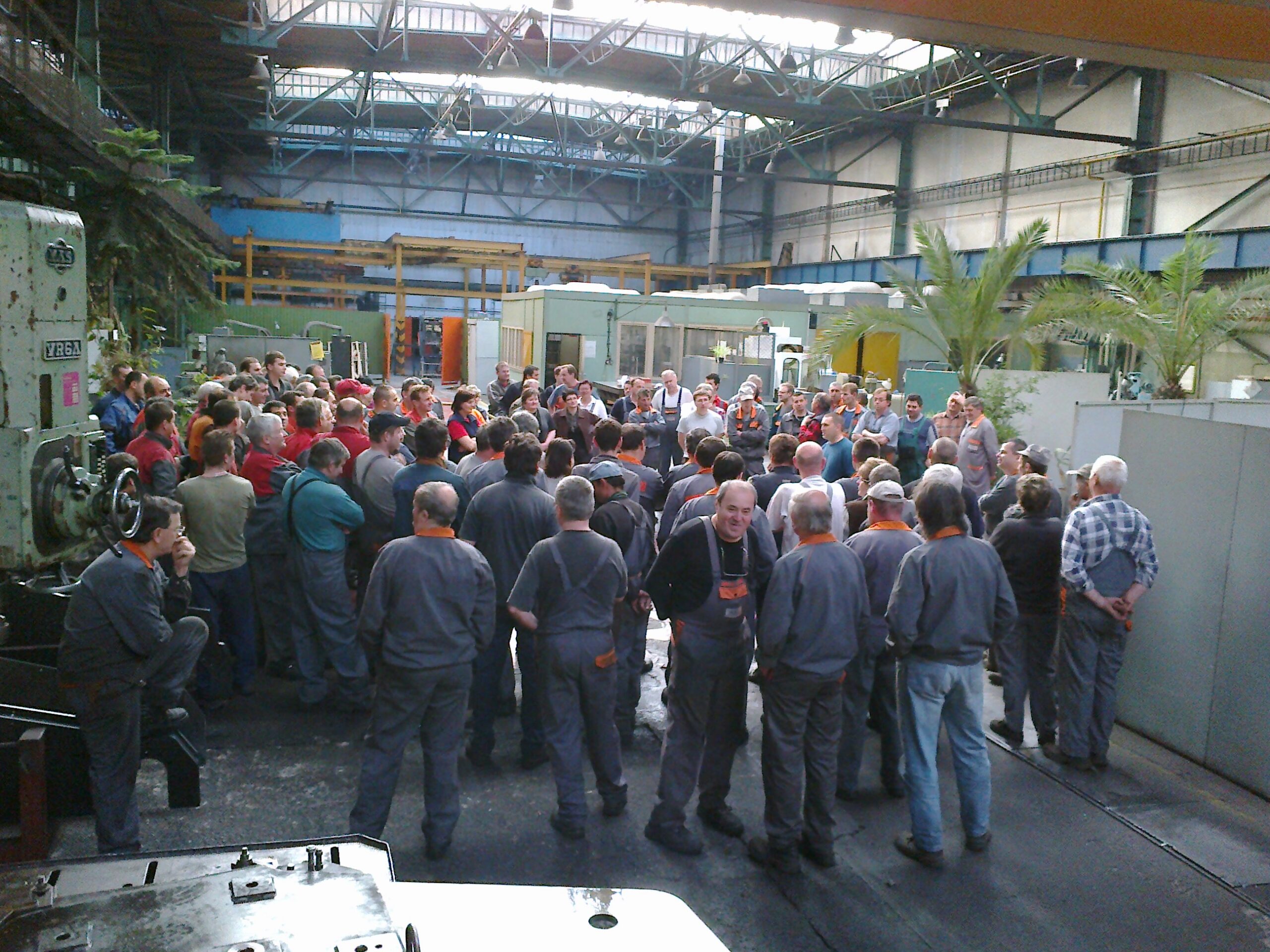
The photo below was taken during one of those discussions directly on the shop floor.
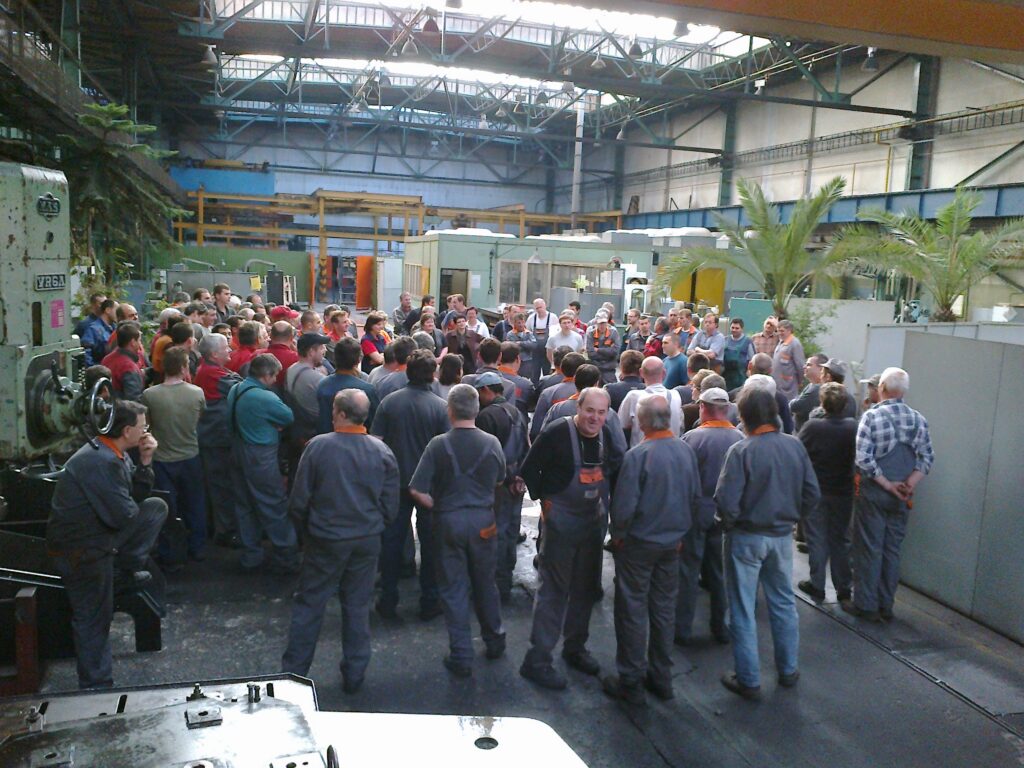
April 2012. I’m on the right in the blue sweater, speaking with the production team during a business transformation.
One lesson became very clear to me in environments like this:
A manager does not need to know more than everyone else about their technical work.
But you do need to know what needs to happen. You need to listen to people who know the work, make decisions, set expectations, stay consistent and take responsibility for the result.
Pretending to know everything destroys credibility surprisingly quickly.
So does avoiding decisions.
People test new managers
I experienced this repeatedly in different companies and different environments.
When a new manager appears, people quickly try to understand what kind of person they are dealing with. Sometimes consciously. Often not.
They bring you problems they could probably solve themselves. They push decisions upward. They fill your day with requests. They watch whether you remember what was agreed, whether you follow up, whether your boundaries are real and whether you lose your temper when pressure increases.
There might be twenty people in the team.
There is one of you.
If every problem becomes your problem, you can lose control of your role surprisingly fast.
I have seen new managers become overloaded not because their team was incapable, but because they accidentally trained everyone around them to escalate everything upward.
That is a dangerous habit to create.
People gradually learn what belongs to them, what belongs to you and where the boundaries are.
That is where authority starts becoming real.
Not because you behave like “the boss”.
Because people learn that you are predictable, fair, competent and consistent.
Managing someone older or more experienced than you
This can feel particularly uncomfortable the first time.
You may suddenly be responsible for someone who is older than you, has twenty years more technical experience, has been in the company far longer or simply knows their profession much better.
That does not remove your responsibility as the manager.
Your job is not to beat them at their profession.
Your job is to create the conditions in which their expertise produces the result the team needs.
You can say:
“You know this area better than I do.”
And at the same time be completely clear about:
“This is the result we need.”
Those two statements are not contradictory.
Respecting expertise does not mean giving up accountability.
When a company grows faster than its management
This is where the problem becomes particularly visible in small and mid-sized owner-led companies.
A founder can often manage three or four people almost personally. Everyone talks directly to the owner. The owner knows what everyone is doing. Decisions happen quickly and problems get solved informally.
That can work surprisingly well.
Then the company grows.
Ten people.
Twenty.
Thirty.
And the same model starts breaking.
The owner becomes the company’s coordination system.
Questions move upward. Decisions move upward. Problems move upward. People wait for answers. The owner’s calendar fills.
Eventually the owner says:
“Why does everything still have to go through me?”
Very often the company has already created titles such as team leader, operations manager or department head.
But titles are not the same thing as management capability.
The company grew.
Its ability to manage did not grow with it.
Sometimes the owner has the same gap. They built the company through technical expertise, sales ability, instinct, energy and relentless problem solving.
That can build a very successful business.
It does not automatically create a repeatable management system.
And if the owner manages mainly through personal intervention, there is very little management system to pass down to the next layer.
This is one of the reasons owner dependency becomes so difficult to remove.
A first-time manager needs an operating system
I disagree with the idea that somebody needs months of leadership education before they can become a functional manager.
Leadership matters. Communication matters. Motivation matters. Emotional intelligence matters.
But a new manager first needs a small set of practical mechanics that make the team work.
I think about them in six parts.
1. Clarity
People need to understand what they own, what result is expected and what good performance actually looks like.
Many supposed “people problems” are really clarity problems. The manager thought something was obvious. The employee understood something completely different. The deadline arrives and everyone is surprised.
A good manager removes ambiguity early.
If people do not know what they are responsible for, everything else becomes harder.
2. Assignment
Saying something is not the same as assigning it.
“Someone should look at this.”
“We need to improve it.”
“Can you deal with that?”
These phrases create a lot of activity and surprisingly little accountability.
A simple structure I use is:
WHAT → WHO → WHEN → EXPECTED RESULT → FOLLOW-UP
What needs to happen? Who owns it? By when? What does finished look like? When will we check progress?
It looks almost too simple.
But a surprising number of management problems disappear when both sides actually leave the conversation understanding the same assignment.
3. Delegation
New managers often make one of two mistakes.
They give work away and lose visibility.
Or they delegate something and then continue managing every detail themselves.
Neither is real delegation.
The amount of direction someone needs depends on the person, the task and the risk.
A new person doing something unfamiliar may need much more direction and more frequent follow-up. An experienced person may need only the result, deadline and boundaries. An expert may need only the objective and constraints.
The skill is knowing where to hold on and where to let go.
That judgment can completely change the performance of a team.
4. Follow-up
Trust and control are not opposites.
A good manager can trust people and still know what is happening.
The problem is not control.
The problem is poor control.
If your only options are checking every five minutes or discovering failure after the deadline, the management system is broken.
Good follow-up happens at the right moment, for the right reason, without turning the manager into a bottleneck.
And this is also where new managers need to resist the temptation to take the work back.
Someone brings you a problem.
Before solving it, ask yourself:
Who should actually own this?
If the answer is the other person, your job may be to help them move forward, not to take over.
5. Feedback and accountability
Problems rarely improve because everyone politely avoids them.
New managers often delay difficult conversations because they do not want conflict. Then frustration accumulates, the conversation becomes harder and what could have been corrected quickly becomes a performance issue.
One of the simplest changes is to stop judging the person and start managing facts.
Do not say:
“You are irresponsible.”
Say:
“The report was due Monday at 10:00. It arrived Wednesday. We could not close the numbers. From next week, I need it every Monday by 10:00.”
One attacks the person.
The other manages behaviour and results.
But there is another layer.
Not every failure has the same cause.
Sometimes the person does not know how. Sometimes expectations were unclear. Sometimes they genuinely could not deliver. And sometimes they simply did not take responsibility.
Those situations require different management responses.
Knowing the difference is part of the job.
6. Management rhythm
This is the part that connects everything.
A manager should not run a team from memory.
They need a rhythm.
Priorities. Numbers. Tasks. Meetings. 1:1 conversations. Follow-up.
A simple system that repeatedly answers:
What matters now?
Who owns it?
How are we performing?
Where are we off track?
What requires management attention?
When this rhythm exists, management becomes much less dramatic.
Problems appear earlier. Responsibility becomes clearer. Decisions happen at the right level.
And the manager stops spending every day reacting to whatever appears next.
First learn to manage
Over the years, I went from managing teams of one, three and five people to middle management, larger operations and organisations involving 100, 150 and 300+ people.
I have managed employees, managers and managers of managers.
The scale changed.
The basic management problems did not.
People still need clarity.
Responsibility.
Priorities.
Follow-up.
Feedback.
Accountability.
And a system that makes execution visible.
That is why I do not think first-time management training needs to be complicated.
It needs to be practical.
Before trying to become an inspirational leader, learn how to set a clear expectation.
Before studying advanced coaching, learn what to do when somebody repeatedly misses commitments.
Before talking about vision, learn how to run Monday morning.
First learn to manage.
Then become a better leader.
If you just became a manager
Do not try to become a perfect leader immediately.
Start with clarity. Learn to assign work properly. Delegate without disappearing. Follow up without becoming the bottleneck. Address problems early. Build a simple weekly management rhythm.
You will still make mistakes.
Everyone does.
But you do not need to learn every basic management lesson the expensive way.
Want to learn the practical system?
I created First-Time Manager, a practical online program for people who have recently started leading a team and need to learn how to actually manage.
Five short practical sessions.
Real management situations.
Workshops.
Immediate application with your own team.
The goal is not to teach you everything about leadership.
It is to give you the core management system you need to become operational quickly.
Learn more about First-Time Manager →
About Stefan Ceman
Stefan Ceman is an operator, business consultant and former senior manager with hands-on experience managing everything from very small teams to organisations involving 300+ people.
He has managed employees, managers and managers of managers across owner-led businesses, international companies, manufacturing environments and major business transformations.
Today, he works primarily with small and mid-sized owner-led companies, helping them build clearer structures, stronger management systems, accountability and businesses that can perform without everything depending on the owner.
His approach to management is practical: clear responsibilities, clear expectations, measurable performance and simple systems people can actually use.
Leave a Reply