
How I turned Dan Martell’s Time & Energy Audit from a 2-week exercise into a 30-day system—and built a Custom GPT to automate the whole thing.
- Tested Dan Martell’s 15-minute Time & Energy Audit for 14 days and extended to 30+ days
- Built a Custom GPT to automate the tracking
- Cut dead time, fixed mornings, eliminated guilt
- Here’s the full system (free): GPT + Google Sheet + Timer App + Process
Why I Avoided This for a Year
I bought “Buy Back Your Time” by Dan Martell a year ago.
Listened to the audiobook. Loved it. Highlighted passages. Nodded along.
Then I did what most people do: nothing.
The Time & Energy Audit sounded brilliant in theory. Track every activity in 15-minute intervals. Assign value and energy levels. Figure out what drains you vs. what energizes you.
But in practice? The thought of logging every 15 minutes for two weeks felt like torture.
“I don’t have time to track my time,” I told myself.
Classic entrepreneur excuse.
What Finally Made Me Start
30 days ago, I hit a wall.
Not a burnout wall—I’ve been there before. Lost €350K. Ended up in hospital. Learned that lesson the hard way.
This was different. I was busy but not productive. Working 10-hour days but couldn’t tell you what I actually accomplished.
Sound familiar?
I had systems for my clients. Process maps. Automation. AI agents running their operations.
But my own calendar? Chaos.
So I made a deal with myself: “Two weeks. Just try it.”
I started Dan Martell’s Time & Energy Audit on September 24th, 2025.
What I Expected vs. What Happened
What I Expected:
Annoying to track every 15 minutes
Would quit after 3 days
Minimal insights (I already “know” how I spend my time)
What Actually Happened:
Day 2: Changed my morning routine
Day 7: Eliminated 3 major time drains
Day 14: Didn’t stop. Still going.
Day 30: Can’t imagine working without it.
I’m writing this on Day 30. Still tracking. Still optimizing.
Here’s why it works.
The Numbers Don’t Lie
After 30 days of tracking, here’s what I discovered:
Before the audit (what I thought):
“I work focused blocks”
“I don’t waste time on social media”
“My mornings are productive”
After the audit (what the data showed):
I was losing 2.5 hours daily to task-switching and “quick checks”
My mornings had 90 minutes of low-value activities disguised as “warming up”
40% of my day was spent on draining tasks I could delegate
Family time was only 15% of my week (when it should be $$$$-value)
The audit doesn’t let you lie to yourself.
The Real Breakthroughs
The 15-Minute Alarm Changed Everything
Every 15 minutes, my phone rings.
Not to log the activity (I do that in bulk). But to ask one question:
“Are you still working on this? Or are you dragging it out?”
That single question cut my dead time by 40%.
You know those tasks that should take 20 minutes but somehow take 90? The alarm kills that. You either finish or consciously decide to continue. No more autopilot time-wasting.
I Fixed My Mornings in 3 Days
Old morning (data from Day 1-2):
6:30 – Wake up
6:45-7:30 – “Warming up” (coffee, random social scrolling, “planning”)
7:30-8:00 – Actually starting work
Reality check: 90 minutes of low-value ($ or $$), half of it draining (RED).
New morning (from Day 3 onward):
6:30 – Wake up
6:45-7:15 – Journaling + deep thinking ($$$ GREEN)
7:15-7:45 – Exercise/cold exposure ($$$$ GREEN)
7:45-8:00 – Breakfast with family ($$$$ GREEN)
8:00 – Start work in Genius Zone
Same time. Different energy. Zero wasted minutes.
I Stopped Feeling Guilty About Family Time
Here’s something nobody talks about: entrepreneur guilt.
You’re with your kids, but mentally you’re thinking about that client email. You’re at dinner, but planning tomorrow’s launch.
The audit fixed this.
I started tracking family time as $$$$ GREEN (highest value, energizing). Because it is.
When the data showed I was only spending 15% of my week on $$$$ activities with my family, I rewired my calendar.
Now? Family time is protected. Not because I “should.” Because the data proved it’s my highest-value activity.
The Problem: Manual Tracking is Painful
After two weeks, I was sold on the method—but exhausted by the process.
Manually writing down every 15-minute block in Google Sheets is brutal.
You start strong, then skip a few entries, then forget what you did an hour ago.
The insights are gold.
But the data entry? Pure friction.
So I did what I do best: automated it.
I Built a Custom GPT to Do the Audit For Me
The GPT acts like a personal performance analyst.
You talk to it like a coach. It listens, logs, and classifies everything you say.
Here’s how it works:
- Every 15 minutes, you tell it what you just did.
Example: “Finished client proposal and replied to two emails.” - The GPT categorizes your task into one of the four Time Value Levels:
- $ = low value (admin, chores)
- $$ = medium value (operations, maintenance)
- $$$ = high value (strategy, creation, sales)
- $$$$ = highest value (vision, family, health, energy)
- It also tags energy:
- GREEN = energizing
- RED = draining
- Every evening, it exports your full day into Google Sheets via Zapier or Make.
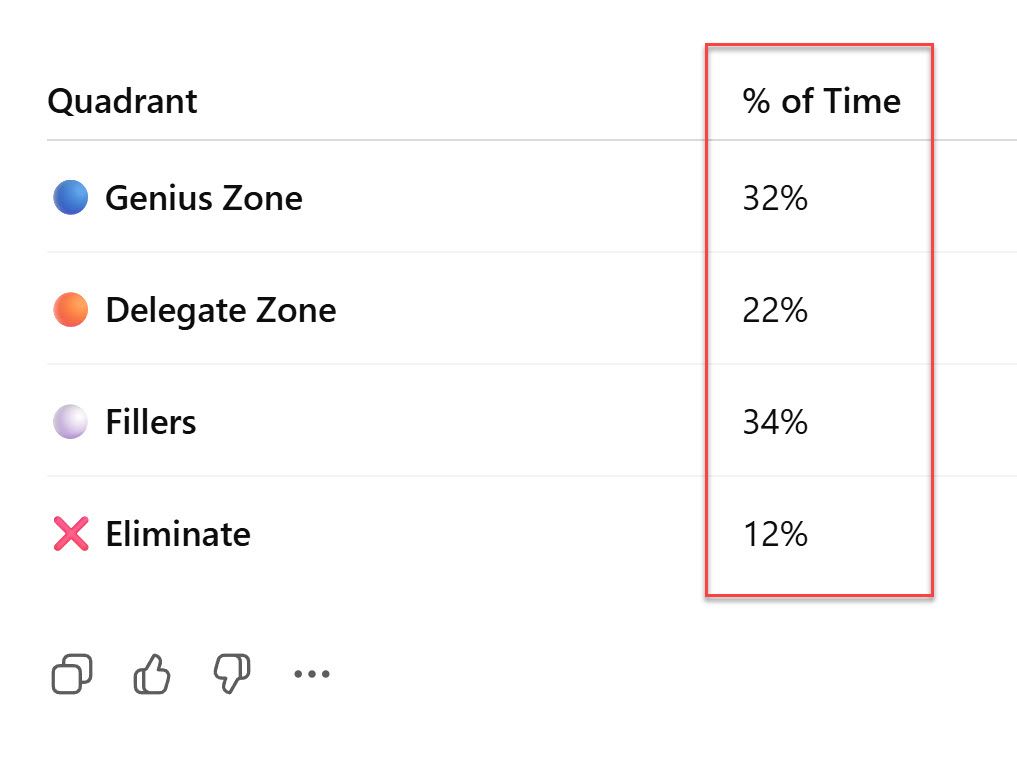
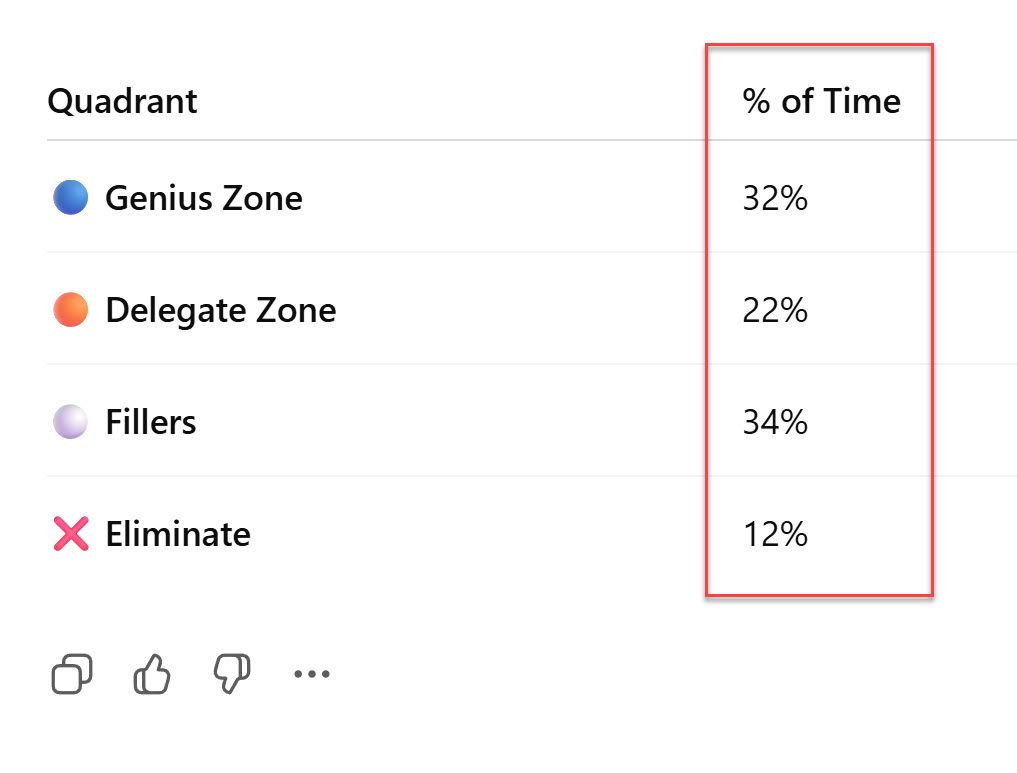
- The Sheet automatically calculates your Genius Zone, Delegate Zone, Fillers, and Eliminate Zone.
What the AI Revealed
Once I automated the tracking, the patterns became crystal clear.
Here’s a snapshot from my 30-day report:
| Category | % of Time | Action |
|---|---|---|
| $$$$ (High Value, Energizing) | 22% | Protect & expand |
| $$$ (High Value, Draining) | 16% | Systemize or delegate |
| $$ (Low Value, Energizing) | 28% | Limit & batch |
| $ (Low Value, Draining) | 34% | Eliminate |
34% of my time was going into activities that neither made money nor gave energy.
These weren’t Netflix binges—they were “productive distractions”: fixing small tech issues, reformatting slides, replying to every message myself.
Once I saw the numbers, decisions got simple:
Delegate or delete.
Unexpected Wins
1. I started napping without guilt.
Data proved naps boosted my energy for the next 4 hours.
That made them a $$$$ activity. No more guilt.
2. I created a “Fillers” category.
Scrolling Twitter, coffee talks, random research—energizing but low-value.
Instead of killing them, I limited them to 45 minutes a day.
3. I built a delegation list that finally made sense.
Instead of guessing what to outsource, I had data:
The 10 recurring $RED tasks became my VA’s new job description.
4. Family time became sacred.
Numbers showed it’s the most energizing and highest-value activity of all.
Now, it’s scheduled first—just like client calls.
The System You Can Copy (Free)
You can run the exact same setup I used.
No coding. No spreadsheets from scratch.
Here’s what’s included:
✅ The Custom GPT – your personal Time & Energy Coach
✅ Google Sheet Template – pre-built with all formulas
✅ Timer App Recommendation – I tested 6, found the most reliable one
✅ My Daily Process Sheet – when, how, and what to log
Once you connect the GPT with your Google Sheets, you’ll have a living dashboard of your time.
Color-coded. Data-driven. Brutally honest.
What You’ll Learn in Week One
- Which 30–40% of your day creates zero value
- Which “productive” tasks secretly drain your energy
- What to automate, delegate, batch, or delete
- Where your Genius Zone actually is—not where you think it is
Final Thought
Dan Martell’s method works because it forces awareness.
My GPT version works because it removes friction.
Together, they create transformation:
Clarity → Focus → Freedom.
If you want the system (free):
Comment “AUDIT15” or email me (stefan@stefanceman.com).
I’ll send you:
→ The GPT
→ Sheet
→ App
→ Full setup guide
No gimmicks. No theory.
Just data that doesn’t lie.
Leave a Reply